Elizabeth Gust: ‘It was hard to feel like it was a normal semester.’
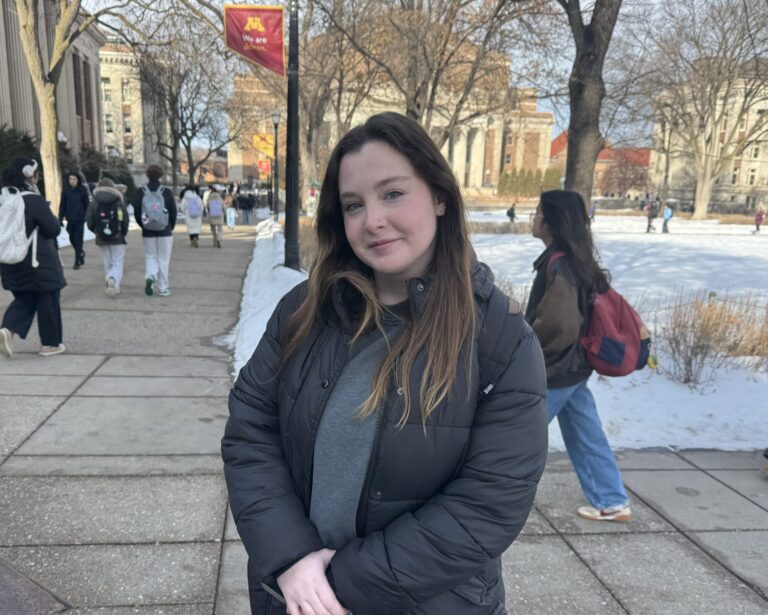
Elizabeth Gust studies political science and English at the University of Minnesota. She is also active in the university’s Human Rights Program.
“I’m from Northern Minnesota, about six hours north of here, and grew up on a farm. But I always knew I wanted to come here for university. I’ve definitely lived in two different sides of Minnesota, I guess socially and culturally. I also really value education. I really love being at the U. I study political science. I’m very civically engaged.
“A lot of people go to school in North Dakota from my high school because it’s just closer, but I knew I wanted to stay in Minnesota. I toured, and I loved being in Minneapolis. I think it’s such a cool city. I definitely chose well.
“So [Operation Metro Surge] began when I was home for winter break. I was in a part of Minnesota that didn’t really care, so that was a little bit hard. The first week after Renee Good was murdered, I was surrounded by people who watched the news, but they were not concerned. And even a lot of them actually thought it was a good thing or whatever. So I was just frustrated. And then I came back to school from break, just in time to start going to the noise demos at the Graduate hotel. I never got arrested or pepper sprayed or anything. I had fine experiences being there. And it was good to see a ton of people show up, especially at the first one when it was still break. And so I think that was when I first was like, ‘A lot of people are really mad,’ and that was only the beginning of what happened. And then Alex Pretti was shot. And I started reconnecting more with my friends after break, and it was all anyone could talk about. Just be like, ‘I don’t know how to, like, act normal right now.’ A lot of people’s — mine, too — classes were all on Zoom, so it was hard to feel like it was a normal semester, because it wasn’t. It was part of being constantly distracted.
“I went to as many protests as I had time for, and I would patrol Cedar-Riverside with one of my friends, because I had shifts of watching for ICE, and you can check a plate database to see if it’s possibly an ICE vehicle or not. So it’s just doing that in between classes [that] obviously really throws off your game when you’re trying to focus on school or work or anything else.
“I would say I wasn’t surprised by how [the Twin Cities community] reacted. I was obviously happy with the way our community is able to band together. But I’m also very involved with the Human Rights Program at the University of Minnesota, and so I’ve seen firsthand the last couple of years just how deeply rooted the human rights infrastructure is in the Twin Cities, specifically there’s just a ton of nonprofits and immigration-related advocacy groups already. And so it’s definitely a city that has the resources and the organizations that are able to respond to things like this, which is good.”
This interview has been edited for length and clarity.
Interview by Alexis Letang