
Disruption and loss: the impact of Operation Metro Surge at UMN
Mental health, grades and trust in democracy and law enforcement declined among UMN students as a result of Operation Metro Surge.
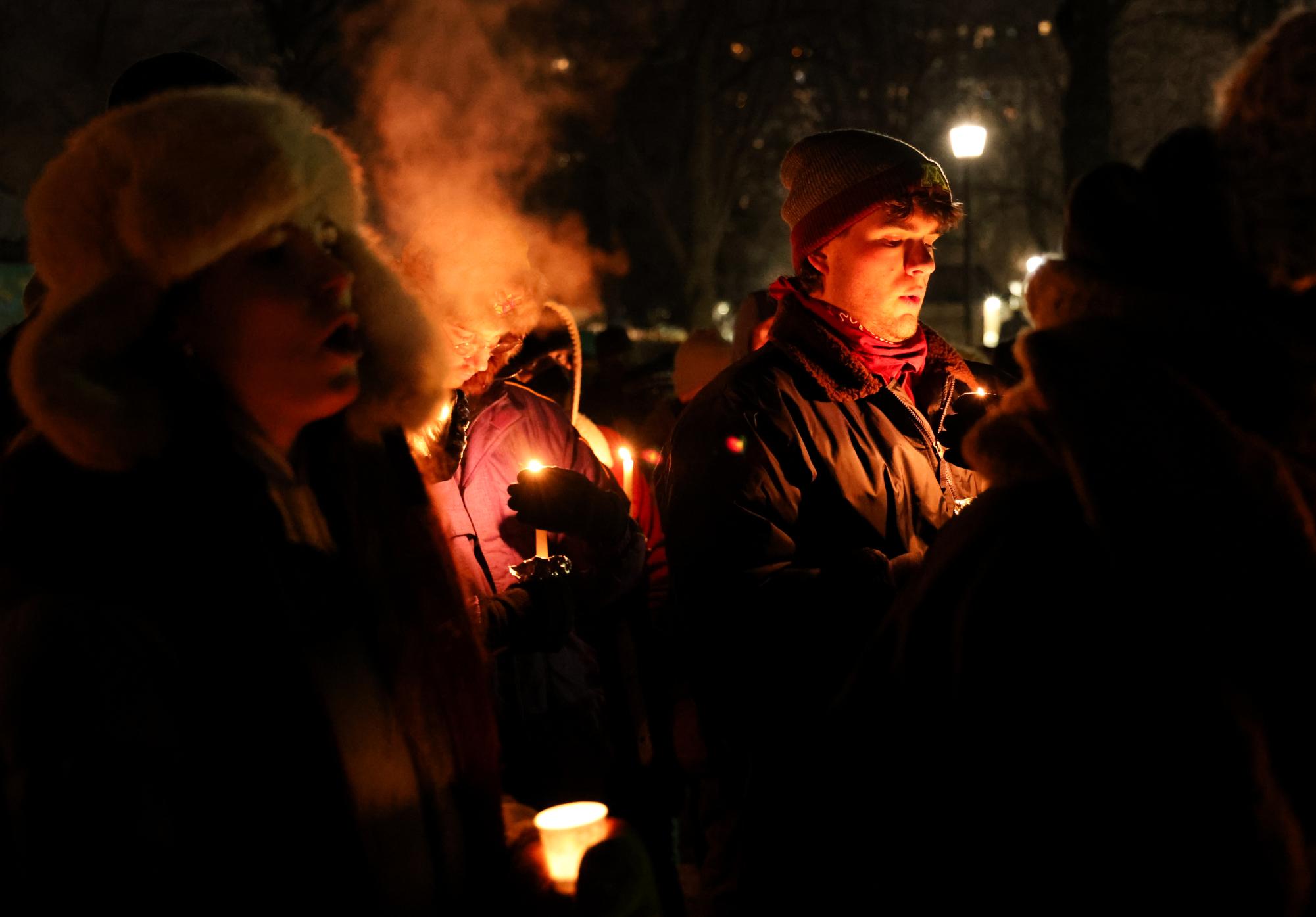
Armed with pots, pans, drums and other noisemaking tools, scores of protesters gathered on Jan. 28 for what was the second noise demonstration of the semester in front of the Graduate hotel in the middle of campus.
The crowd was drawn by rumors that agents with U.S. Immigration and Customs Enforcement (ICE) were lodging at the hotel. By 11 p.m., 67 protesters — many of them students — would be in police custody.
Though only a handful of protestors faced more than a fine from law enforcement, many students who watched or heard about the arrests of their peers said the actions of law enforcement that night were unnerving. Students were already concerned about reports of ICE agents on campus, and the sight of the University of Minnesota Police Department, alongside state and local agencies, clamping down on students in a peaceful demonstration caused them to question the officers’ peacekeeping priorities.
“Are they here to protect us or to make sure we’re in line?” Alexi Hadjistamoulou, a third-year student, asked
The erosion of trust in law enforcement was just one of several losses students said they experienced during Operation Metro Surge. From weakened faith in democracy to reduced mental health and declines in academic success, students at the university reported feeling a chain of losses from the events of the early spring semester.
An AccessU: Upended survey conducted in March chronicled these losses:
- About 60% of respondents said Operation Metro Surge adversely affected their mental health. Of them, 45% said the impact was significant or very significant.
- More than two-thirds of respondents said their classes were affected by modality change due to Operation Metro Surge, and over half of those affected said it somewhat interfered with their learning.
- More than 62% of respondents said their trust in law enforcement was significantly lower or a little lower than it was before Operation Metro Surge began.
- Almost half of respondents — 49% — said their faith in U.S. democracy was “significantly lower” following the surge.
The survey, sent to 5,000 randomly selected University of Minnesota undergraduate emails, had 298 responses. Some survey respondents gave their names and contact information for follow-up interviews, which AccessU reporters conducted in early April.
In those interviews, and in comments survey respondents made, students also cited lost friendships from the overt and subtle polarization around ICE’s presence as casualties of the surge. Many students also mentioned the murders of Renee Good and university alum Alex Pretti, which created grief and anger across the campus.
“There’s massive loss that occurred and I think just general erosion of public trust as well,” said Riley Stern, an economics and mathematics senior at the university.
Mental health
Many students said in interviews that ICE’s actions and presence in the Twin Cities added to the everyday stress of being a college student.
Allison Erickson, a third-year political science student, said while she did not feel targeted by ICE, she felt worried on behalf of her friends who felt the need to carry their documentation. Constantly keeping up with the news also affected her mental health.
“It felt very tense all the time,” Erickson said. “So I felt like my anxiety was a little higher.”
Erickson’s anxiety lessened after border czar Tom Homan announced Operation Metro Surge would begin to wind down on Feb. 12. But “the after-effects of ICE in the city,” she said, “have still kind of made me anxious or on edge.”
Other students also cited the constant flow of news and information as a source of anxiety, adding that the intensity of the news during the surge reflected a concentrated version of an ongoing challenge Americans continue to face with their mental health.
Isabella Crotteau, a fourth-year at the university, said while she feels that her mental health is returning to normal, there are still events beyond the actions of federal agents that are troublesome to hear about.
“I feel like we have been constantly overwhelmed by the news and bad things happening within the U.S. that we are able to kind of compartmentalize,” Crotteau said.
Kit Breshears, communications director and faculty member at the Earl E. Bakken Center for Spirituality & Healing, said that during Operation Metro Surge, people paid more attention to the news than they did previously — a natural response.
“That’s understandable because of the events that were happening here, and we’re wired to find things that might be a threat to us,” Breshears said. “And there were plenty of threats.”
Breshears said social media allowed people to check in on their community, which gave people a sense of control.
However, the issue is the 24/7 news cycle created by social media and technological advancements. Breshears explained that humans were not designed to constantly consume news.
“We’re getting all of the news, but we’re not giving ourselves time to process it, and so that’s creating significant stress,” Breshears said.
Some students were able to keep their mental health intact throughout the surge. Third-year law student Ahmad Wazwaz said he thinks his longtime involvement in politics gave him resilience.
Accepting the circumstances is a big part of his strategy, Wazwaz said, something he learned after Donald Trump was elected for a second term.
“I took a day off of work, accepted it, and told myself that no matter how bad things get, you can’t let it affect you, because that really is the goal of everything that this administration is doing,” Wazwaz said. “I think once you learn to understand why things are happening, it affects your mental health a little bit less.”
Classes and grades
Grades and motivation took an unexpected turn at the start of the semester as stress, fear and uncertainty triggered by Operation Metro Surge made it difficult for students to focus.
More than 70% of students reported in the AccessU survey that their classes were affected by the events of the surge. Among those whose classes were affected, more than half said the surge somewhat interfered with their learning.
Some students related their issues in the classroom to mental health declines.
“It definitely affected my mental health, and it affected my grades,” said a university first-year student and survey respondent who was interviewed but did not want to be named. “My GPA this semester is horrible.”
A major issue students identified was the lack of a clear, unified response from the university. Instead of one consistent policy, decisions about class format were left up to individual professors and departments.
While some professors offered flexibility or remote options, others did not.
Stern said the inconsistency of modality changes between departments complicated the schedules of students taking classes in several.
“That’s not really helpful for a lot of people,” Stern said. “I think that the university should have taken a lot more initiative to be assertive on that front.”
Safety concerns also played a big role in students’ ability to engage in class, particularly among students of color and students from immigrant communities taking in-person classes.
Although the university introduced temporary virtual learning options, many students found the move to be insufficient. Others noted that they were required to advocate for themselves to receive accommodations, adding yet another layer of pressure.
Peyton Gewedik, a first-year political science student, said he felt uneasy about how the university handled online classes as well as required U-Card access to campus buildings at the start of the semester.
“It makes me feel unsafe,” Gewedik said, adding that it was only because his instructors extended hybrid learning options beyond the university’s established hybrid period that he was able to manage his fears.
Professors themselves noticed the impacts. Jazmin Danielson, a sports ethics professor and university youth safety and compliance manager, said she noticed the disruption affected students’ ability to concentrate on their academics.
“When students don’t feel comfortable in their environment, it becomes much harder for them to stay focused and do well in class,” Danielson said. She said she noticed more missed classes and less participation.
Even as the momentum of the surge declined, the effects on the campus community were not swiftly swept away. Almost 14% of survey respondents said their motivation to adhere to their academic plan at the university was a little or significantly lower.
“Some students took longer to get back into a normal routine,” Danielson said. “You could still see it in their engagement.”
Elizabeth Gust, a junior at the university and a political science and English major, said her substantial involvement with protests against ICE threatened the stability of her day-to-day life, including her academics.
“I went to as many protests as I had time for, and I would patrol Cedar-Riverside with one of my friends,” Gust said. “So it’s just doing that in between classes that obviously really throws off your game when you’re trying to focus on school or work or anything else.”
Loss of faith in democracy
Nearly half of the survey respondents said that their faith in American democracy was “significantly lower” following Operation Metro Surge. An additional 23% said it was “a little lower.”
For some students, this has shaped their personal political views. Crotteau said she will only be voting for candidates in the fall who actively opposed Operation Metro Surge.
”I think our representatives could be doing a lot more politically within their power,” Crotteau said.
In AccessU: Upended’s survey, more than half of respondents said they had become more politically involved since the beginning of Operation Metro Surge, although most said their political views remained unchanged. Roughly 47% of respondents said the events of Operation Metro Surge would impact their vote in the upcoming midterm election.
Paul Goren, a political science professor at the University of Minnesota, said the actions taken by immigration agents during Operation Metro Surge will most likely have a severe negative impact on Republican candidates going into the midterms this November.
“When you have these heavy-handed actions by the state or federal government to crack down on a specific group, you see pushback that is very strong and after effects that are very lasting,” Goren said.
Many students acknowledge the surge inflamed political polarization in their families and, to some extent, on campus. Stern said it was challenging to maintain ties with people who chose to detach from events.
“There were a couple friendships I have where I felt that people weren’t being as engaged as I’d like to them to be in their privileged position,” Stern said. “And I kind of have maybe changed those relationships since.”
The survey showed small but discernible campus support for ICE’s goals. For example, while only 10% of respondents said the long-term outcome of Operation Metro Surge was positive, one of the two main reasons they selected was “the sense that we are safer because of ICE’s work.”
Goren said that for Minnesota’s demographics as a state, this is unsurprising. Much of the state outside of the Twin Cities leans more conservatively, and thus would be more likely to be in support of ICE
Two AccessU: Upended reporters tried to contact conservative students for their views on the surge by seeking interview subjects at a Turning Point USA campus gathering in April, but all attendees approached by reporters refused to be interviewed.
For most students who responded to the survey, and in interviews conducted throughout the semester by AccessU: Upended reporters, the surge was highly unpopular. Jaxxon Handy, a fourth-year, said he felt upset by the menacing atmosphere, particularly for students of color, that had developed around campus during the surge.
“It made me angry that, as a U.S. citizen, I even had to think about whether it was safe to walk around in public,” Handy said.
Long-term outlook
Khanhlam Lambuu, a Vietnamese first-year neuroscience student, said the fear of ICE agents changed the way both she and her friends lived their lives.
“Whenever I talked with my friends, who were people of color and Asian, we always ended up going to the topic of how we’re just anxious that one person we know could get stopped by ICE,” Lambuu said.
Other reports on the impacts of Operation Metro Surge echo these findings. According to a survey conducted by the U.S. Immigration Policy Center in March, 54% of respondents in Minneapolis said they were randomly stopped by ICE while walking down the street, with 46% saying that ICE agents did not believe them when they said they were lawful U.S citizens.
For some students, faith in the government’s interest in protecting people has not returned, even after Operation Metro Surge ended. Anja Waage, a first-year music student, said the federal government no longer seems interested in protecting people’s civil rights under the U.S. Constitution.
“There’s just not much prioritization for the American citizens in their safety and what they’re going through on a day-to-day basis,” Waage said.
During the surge, Waage said she carried her passport with her even though she was a citizen. Although she no longer carries her identification documents, she said she still suspects that the government “would have no problem starting Metro Surge again.”
When asked if they thought the long-term effects of Operation Metro Surge were positive, negative or nonexistent, the majority of respondents said negative with 55% of respondents citing concerns about safety on and off campus as a reason.
Throughout the semester, students interviewed by AccessU: Upended reiterated that one positive outcome of the surge was the way the community came together.
“This is how the community has always been; it’s just that we haven’t had to show it,” said Mascuud Ali, a fourth-year student studying early childhood education.
Ali compared Operation Metro Surge to the aftermath of the murder of George Floyd, stating it was another instance when the community came together during a stressful time.
But students also say any gains in community identity following Operation Metro Surge don’t outweigh the loss people faced after federal agents descended on the cities. The community that came together was there before the ICE agents arrived.
“There are still people missing. There are still neighborhoods that are scared. There are still people looking for answers,” said Lanah Suing, a second-year political science major. “I think the only good things that came out of it were, of course, community, and that had nothing to do with Operation Metro surge itself.”


