
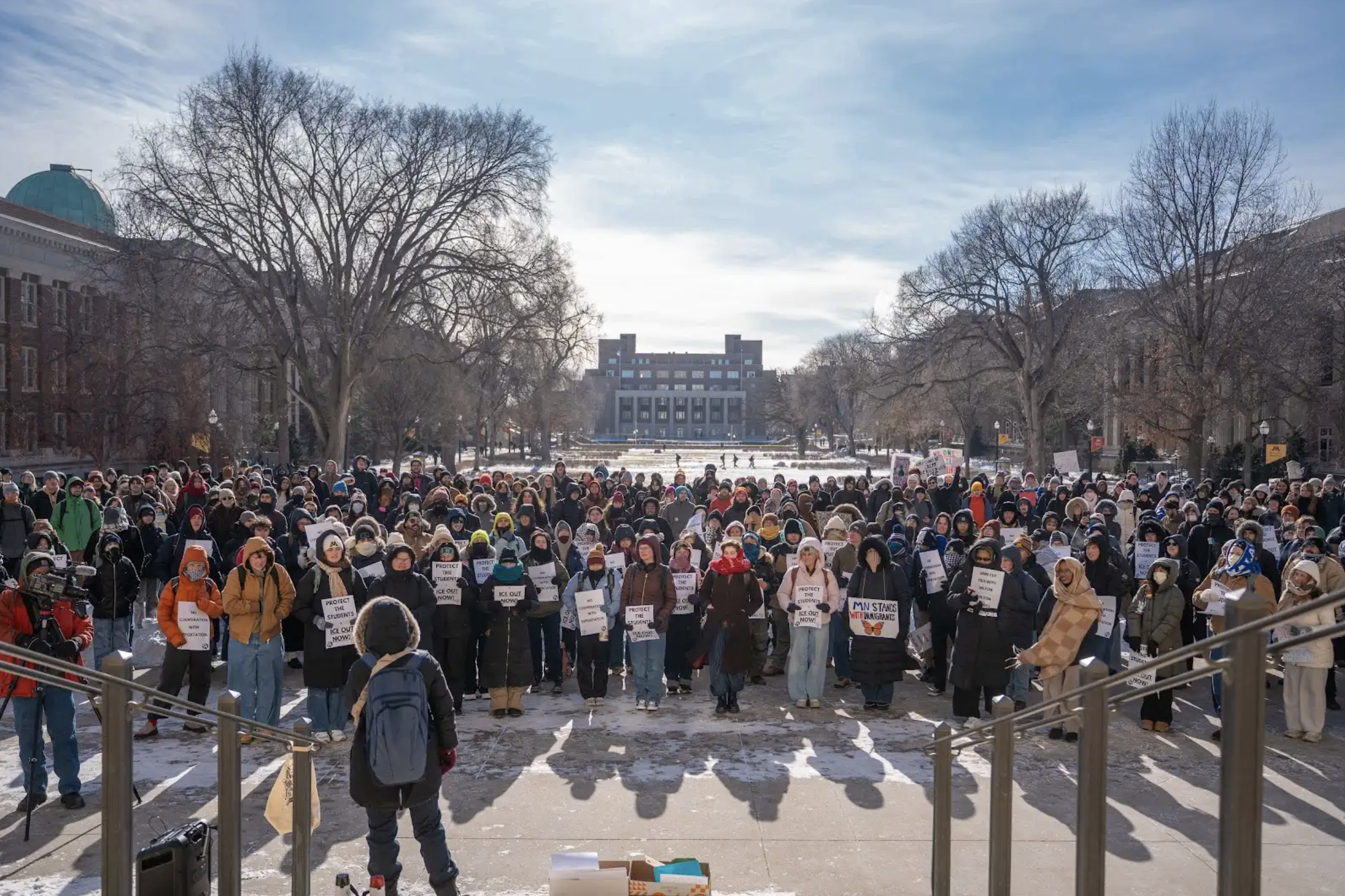
Students dissatisfied with UMN response to Operation Metro Surge
The university’s policies on immigration lack protections and clarity, students say — a shift from years prior.
On his way back from the gym, third-year University of Minnesota student Mascuud Ali turned the corner onto the street of his Hopkins apartment and found the whole block surrounded by federal agents.
Unable to make it any farther, Ali stared on from the sidewalk as more than 10 law enforcement vehicles lined the streets. He could not get home for seven hours.
Now every time he goes home to his neighborhood, where a large Somali population resides, he has to make sure it’s safe to do so first. He checks his neighborhood group chats and scans the ICE watch platforms, which monitor reports of U.S. Immigration and Customs Enforcement officers, on his phone to see if federal agents are nearby.
“I’ve also had to carry my passport at all times,” Ali said. “It’s very unsettling.”
Ali, like many other students who faced challenges during Operation Metro Surge, had to carry on with his life and keep up with his studies. Many sought guidance from the university on a range of issues, asking questions about how to stay safe, how to seek mental health help and how to support students with immigration concerns. Some students just wanted events to bring the campus together at a time when the city seemed under siege.
But aside from a “rapid response” page with general safety guidelines and a mandate requiring U-Card access to all campus buildings, the university did little, opting to stay neutral and generally quiet.
Many students found the university’s response insufficient.
“The university might not necessarily have the resources to immediately support us, but there wasn’t much of an effort to find those resources either,” said Anja Waage, a first-year music student at the university. “They just sent out one email being like, ‘Hey, we’re here to support you,’ and never even directly addressed in what — they didn’t address Operation Metro Surge.”
Similar concerns were reflected in a March survey, conducted by AccessU: Upended, that captured the first snapshot of university undergraduate students’ experiences during the federal immigration enforcement operation in Minneapolis, as well as their opinions on the university’s response to the surge.
The majority of these students said they were dissatisfied with the university’s response and also expressed a desire for clearer communication regarding their safety concerns.
Roughly half of the respondents said the university failed to prioritize student safety during the surge. Only 28% said their safety had been prioritized. Similarly, nearly half of the respondents disagreed or strongly disagreed that the university communicated and executed clear safety plans. Nearly a quarter of respondents agreed.
AccessU: Upended reporters also interviewed survey respondents who left their names and contact information. Many of those echoed the concerns and explained their views regarding university inaction, saying protocols around classroom modality were confusing, and they had to change daily routines and campus travel routes to avoid possibly running into ICE.
When asked to comment on the findings of the survey, the university responded in a statement: “The University’s top priority is always the safety and well-being of our students, faculty, staff and visitors.”
Making campus a sanctuary
According to the survey, 68% of respondents agreed or strongly agreed that the university should have declared itself a sanctuary campus. Although the university stated it was committed to prioritizing the safety of its students, faculty and staff, no declaration of sanctuary status was made.
Linus Chan, clinical professor of law at the University of Minnesota Law School and the faculty director of the Detainee Rights Clinic, said the term “sanctuary campus” has a symbolic meaning that is usually used to illustrate a university’s commitment to prioritizing student safety.
“There’s no such thing as a sanctuary campus. That’s not an actual legal term,” Chan said. “Usually, when people say sanctuary city or sanctuary campus, what they’re really talking about is whether the institution, in this case the university, will willingly cooperate with immigration enforcement.”
Chan said the university was put in a tough position because declaring itself a sanctuary campus could have put federal funding for itself in jeopardy. Still, Chan said, he believed the administration’s response lacked depth and left much up for interpretation.
“They could have made things clearer,” Chan said. “Other universities did more than just say, ‘We are not gonna cooperate.’”
Although students recognized that the university put safeguards in place for students worried about ICE, many said the university’s language fell short of conveying a sense of solidarity.
While the University of Minnesota is one of many higher education institutions that have not declared themselves a sanctuary campus, a handful around the country have adopted the symbol of solidarity with students.
The Department of Homeland Security initiated Operation Black Rose in Portland, Oregon, in September 2025, an operation that lasted into 2026. The enforcement with over 1,100 people detained across the state, Oregon Public Broadcasting reported. Portland State University (PSU), located in the city’s downtown, has been a sanctuary campus since 2016.
“While there is no established definition of a ‘sanctuary campus,’ at PSU we view it as a commitment to take whatever steps we can to protect all of our students regardless of immigration status,” the PSU Office of General Counsel said on its website.
PSU’s main tenets of its self-described sanctuary status include a policy that campus police won’t assist ICE and the university won’t provide ICE information.
From defiance to compliance
In the years before Operation Metro Surge and during the ongoing tensions surrounding immigration under the first Trump administration, the University of Minnesota was more vocal about its commitment to immigrant and international students’ safety.
In a 2017 State of the University address following a Trump administration executive order on immigration, then-President Eric Kaler said the university and its community had a responsibility to support and protect its immigrant and undocumented students.
That same year, the university created an Immigration Response Team to support students and faculty affected by federal visa restrictions. The Young Democratic Socialists of America at the university are currently petitioning to revive that now-defunct response team as a part of their demand for a sanctuary campus.
In 2020, the university joined a list of nearly 60 universities filing amicus briefs supporting a lawsuit that challenged new ICE restrictions on visas for international students.
“We cannot stand by in good conscience as international students are forced out of the country through no fault of their own,” said then-President Joan Gabel in a university news release. “We stand with our international students, and international students across the country, in asking that the ICE directive be overturned immediately.”
Yet when the second Trump administration took office in January 2025 and issued directives designed to broadly crack down on immigrants — including enhanced screening for international students — the administration’s statements differed in tone and effect. That month, the university announced that it would comply with federal court orders regarding ICE.
“How the University responds would depend on the specifics of each situation,” former university spokesperson Jake Ricker said in a 2025 email statement to the Minnesota Daily. “While the University does not have responsibility or an active role in federal officials enforcing federal law or court processes, as a public university and employer, we cannot ignore federal court orders or subpoenas.”
Prioritizing procedures
One year later, as thousands of federal agents were deployed to Minneapolis, the administration’s statements remained focused on “rapid response” guidelines, inclusivity statements and memorials for alumnus Alex Pretti, who ICE agents killed in late January. Administrators did not release a statement immediately following the death of Renee Good.
According to the AccessU: Upended survey results, as well as subsequent interviews with students, the university administration’s messages fell short for many students in offering support.
Roughly 60% of survey respondents disagreed or strongly disagreed that the University of Minnesota did all it could to support students after the murders of Renee Good and Pretti.
“The university, I feel, has more of a passive approach to campus safety; the resources that are available on campus need to be talked about more and shared,” said Kaylyn Holland, a student at the University of Minnesota. “It seemed like the university wanted to help, but what they did, I don’t think was adequate.”
For the most at risk, the administration’s messages fell short in offering what they needed most: a way to feel safe. Much of this was tied to the administration’s decision to leave class modality in the hands of departments, university students and instructors said.
In January, the Office of the President offered a statement to the campus community that read, “We are empowering learning accommodations (including hybrid) and shared this direction with deans, faculty and instructors earlier today.”
The guidance was initially confusing, said a graduate student instructor from the department of Spanish and Portuguese studies, who did not want her name used for safety concerns. She said neither she nor her students were ready to meet in person because they feared for their safety. Only when she reached out to her department head for guidance was she able to offer flexibility.
“So in that sense, I was kind of feeling supported somehow, that they understood the situation and what was going on,” the instructor said. But many students said other departments grant instructors the same freedom.
“From what I could tell, all my professors didn’t really know what was going on, or what the protocol was for the university,” said third-year student Allison Erickson. “That was kind of hard to navigate, especially if you’re a student who’s worried about being targeted by ICE. They tried, but they fell short.”
A moral obligation
Third-year law student Ahmed Wazwaz said he felt the university had a moral obligation to protect students during the surge by keeping ICE off campus.
“If you hold a position that ICE is immoral — they’re essentially kidnapping people, they’re untrained goons — it does beg the question how you can claim that they supported the students in any way if they allowed ICE to stay here,” Wazwaz said.
However, an undergraduate student, who asked to remain anonymous due to mental health concerns, said it’s difficult to judge whether the university administration did all they could do with their power, especially given the current political situation.
“I don’t know if they did everything that they could because they know what they can do with their power,” the student said. “I don’t know if the university president has the ability to say no to anything that the American president says. I wish it weren’t left up to the little people to sit and protest and do something.”
For Wazwaz, the university’s response to Operation Metro Surge has left him with many questions and disappointments.
“If they truly did care about their students, we do know what actions they could have taken,” Wazwaz said. “Now, would that have resulted in federal backlash, a possible violation of the law? Sure, but as we’ve seen, a law existing is not the same thing as whether something is good or evil, whether it’s moral or not.”
Wazwaz added that, amid ongoing Diversity, Equity and Inclusion (DEI) rollbacks and compliance with ICE, students worry they might see the university submit more to the demands of the Trump administration.
“I think most students are just prepared to be completely disappointed,” he said.
But the people of Minneapolis gave students what the university has not been able to definitively provide — a reason to hope.
For Mascuud Ali, the way Minneapolis as a community has chosen to respond in dark times demonstrates its true character, a trait he said has remained beyond the initial operation.
“In times of stress, people show their true character, Ali said. “And right now, the true character of Minnesota is one of resilience, and they’re fighting back.”


